

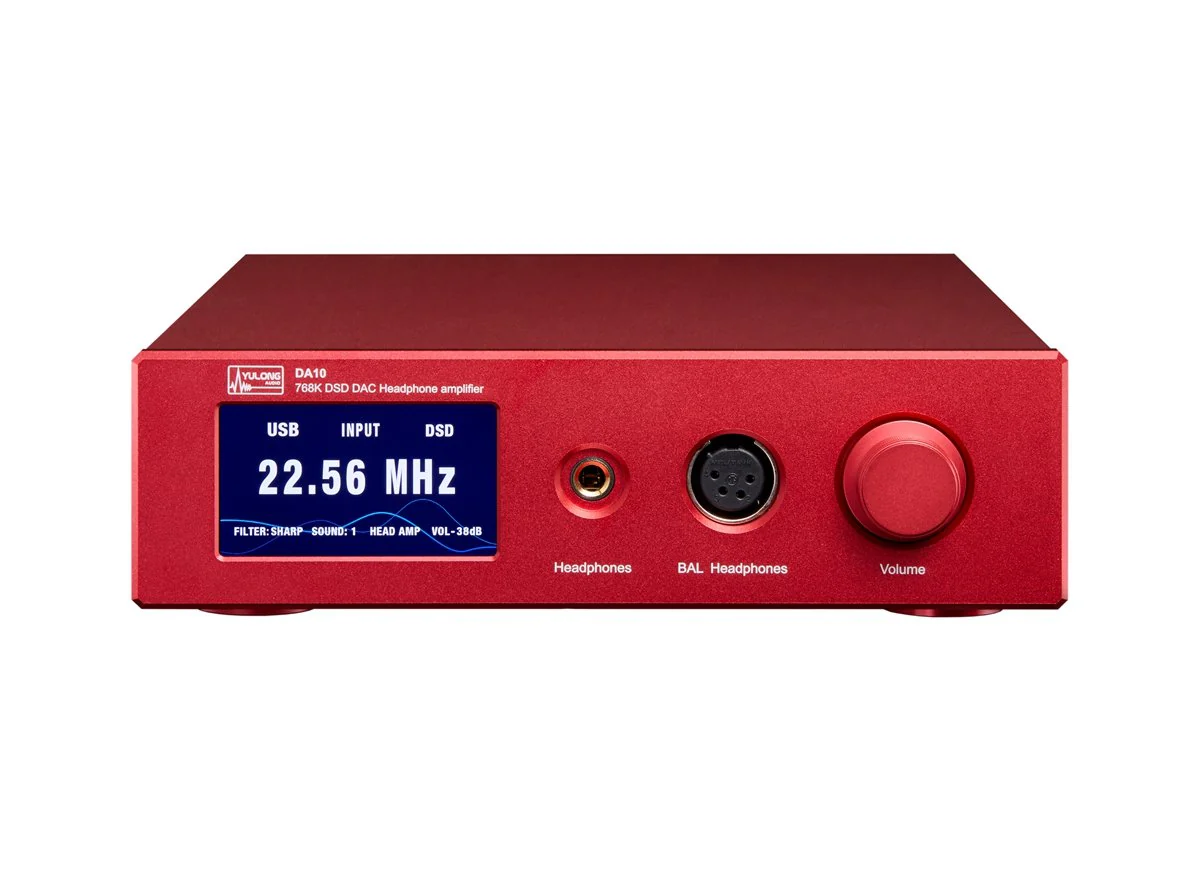

Yulong DA10 DAC/Amp
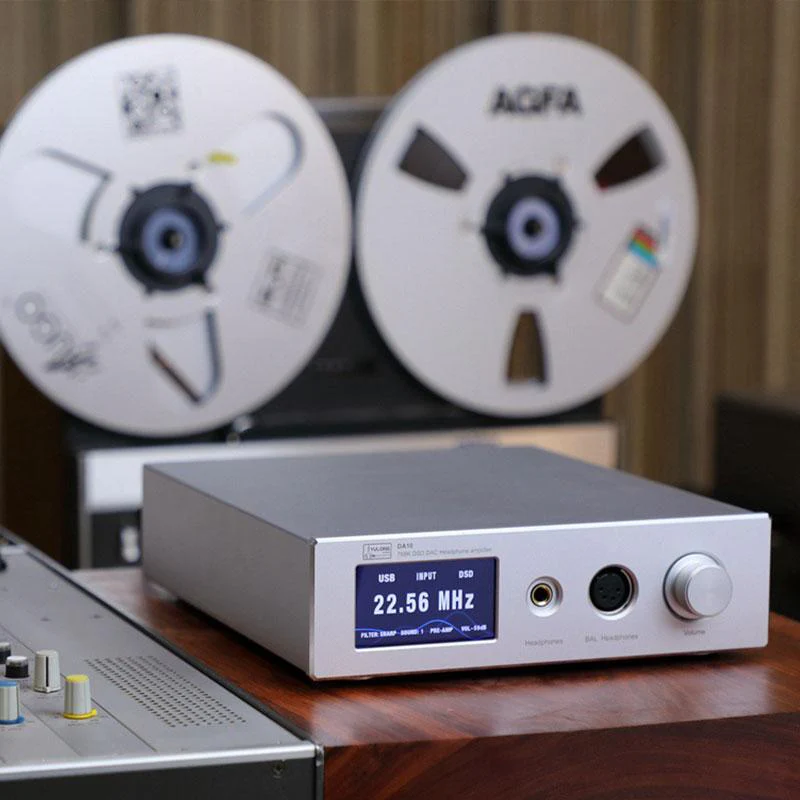
If you’ve been looking to jump into the big leagues of DAC/Amps, you really can’t go wrong with Yulong’s all-new flagship DAC/preamp/amp, the DA10. This feature-rich desktop powerhouse is capable of handling whatever input, headphone, or file type you throw its way.
Jitter Eliminator
Jitter is this generation’s disc skip--it’s aggravating, intrusive, and could potentially ruin a listening experience. Okay, maybe it’s not as intrusive as disc skip, but it should be avoided at all costs. The DA10’s PLL clock, powered by a femtosecond crystal, transforms digital sequences to analog at a quadrillionth of a second, making jitter a thing of the past.
Power Meets Refinement
Through an ingenious system of checks and balances, the DA10 achieves both massive output and discreet presentation. Its brawny, 600 ohm Class-A amp is offset by an ultra-quiet toroidal transformer, 23 noise regulators, and a low-distortion output buffer. What you get is a powerhouse with table manners.
Calling All Customizers
Let’s start with the DA10’s customizable sound modes. When was the last time you used a DAC/Amp to EQ your music? With three unique sound modes, you can strike an EQ band that suits your tastes. Throw in a user-customizable digital filter, a 99-step volume control, and an FPGA-based DSP, and you’ve got yourself a system that’s perfectly personalized.
Specs:
● DoP64 and DoP128 support over SPDIF/Optical/AES
● PCM 384KHz 24bit over SPDIF/Optical/AES
● DoP64, DoP128, Native DSD64/128/256 /512and PCM 16-32bit, 32-768KHz over USB
● SNR: -130dB
● Dynamic Range: 125dB
● THD+N: 0.0003%
● Frequency Response: 20-30KHz-0.15dB
● Crosstalk < -120dB
● Balanced Output level: 4.2V
● Single-end headphone amp 600ohm:110mW 300ohm:230mW 150 ohm:460mW 32 ohm:2W
● Balanced headphone amp 600 ohm:230mW 300 ohm:460mW 150 ohm:930mW 32 ohm:3W
● Headphone output THD+N< 0.001% at full power
● Power consumption: <30W
● Size: 248*210*60mm
● Weight: 4Kg
Manufacturer’s Notes
SSLOW mode reduces the high frequency by a large margin and makes performance measurement such as frequency response and distortion significantly worse than the published number. This mode is mainly for experiment purpose.
DA10 outputs 2V RMS for single ended and 4V RMS for balanced line levels that is commonly seen in consumer market. These levels are equivalent to about +8dBu and +14dBu which is lower than some professional gears that has hotter outputs such as +18dBu or 6.15V RMS, +20dBu or 7.75V RMS, or +24dBu or 12.28V RMS. Level matching is recommended when comparing between different equipment, as LOUDNESS often sounds better for audiences even the professionals.
Original: $1,092.00
-70%$1,092.00
$327.60Product Information
Product Information
Shipping & Returns
Shipping & Returns
Description
If you’ve been looking to jump into the big leagues of DAC/Amps, you really can’t go wrong with Yulong’s all-new flagship DAC/preamp/amp, the DA10. This feature-rich desktop powerhouse is capable of handling whatever input, headphone, or file type you throw its way.
Jitter Eliminator
Jitter is this generation’s disc skip--it’s aggravating, intrusive, and could potentially ruin a listening experience. Okay, maybe it’s not as intrusive as disc skip, but it should be avoided at all costs. The DA10’s PLL clock, powered by a femtosecond crystal, transforms digital sequences to analog at a quadrillionth of a second, making jitter a thing of the past.
Power Meets Refinement
Through an ingenious system of checks and balances, the DA10 achieves both massive output and discreet presentation. Its brawny, 600 ohm Class-A amp is offset by an ultra-quiet toroidal transformer, 23 noise regulators, and a low-distortion output buffer. What you get is a powerhouse with table manners.
Calling All Customizers
Let’s start with the DA10’s customizable sound modes. When was the last time you used a DAC/Amp to EQ your music? With three unique sound modes, you can strike an EQ band that suits your tastes. Throw in a user-customizable digital filter, a 99-step volume control, and an FPGA-based DSP, and you’ve got yourself a system that’s perfectly personalized.
Specs:
● DoP64 and DoP128 support over SPDIF/Optical/AES
● PCM 384KHz 24bit over SPDIF/Optical/AES
● DoP64, DoP128, Native DSD64/128/256 /512and PCM 16-32bit, 32-768KHz over USB
● SNR: -130dB
● Dynamic Range: 125dB
● THD+N: 0.0003%
● Frequency Response: 20-30KHz-0.15dB
● Crosstalk < -120dB
● Balanced Output level: 4.2V
● Single-end headphone amp 600ohm:110mW 300ohm:230mW 150 ohm:460mW 32 ohm:2W
● Balanced headphone amp 600 ohm:230mW 300 ohm:460mW 150 ohm:930mW 32 ohm:3W
● Headphone output THD+N< 0.001% at full power
● Power consumption: <30W
● Size: 248*210*60mm
● Weight: 4Kg
Manufacturer’s Notes
SSLOW mode reduces the high frequency by a large margin and makes performance measurement such as frequency response and distortion significantly worse than the published number. This mode is mainly for experiment purpose.
DA10 outputs 2V RMS for single ended and 4V RMS for balanced line levels that is commonly seen in consumer market. These levels are equivalent to about +8dBu and +14dBu which is lower than some professional gears that has hotter outputs such as +18dBu or 6.15V RMS, +20dBu or 7.75V RMS, or +24dBu or 12.28V RMS. Level matching is recommended when comparing between different equipment, as LOUDNESS often sounds better for audiences even the professionals.